




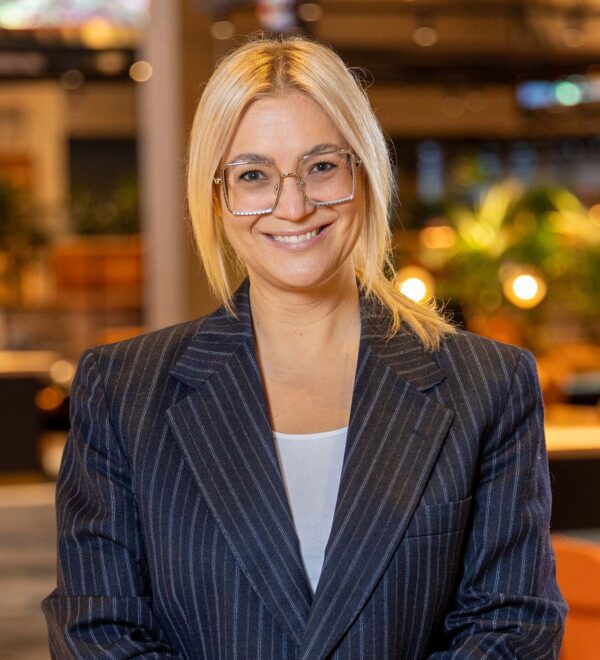
Moa Tyborn has extensive experience leading and driving change in complex and rapidly evolving organisations. With a background as a Marketing and Communications Director in several international companies, she has worked closely with the business on transformation, positioning and profitable growth in industries facing significant change. Alongside her executive career, she has developed extensive experience in board work and investments in smaller companies.
We met with Moa to discuss modern leadership, the role of the board in creating strategic direction, and how interim management can act as an accelerator when organisations are facing transformation. We also discussed the importance of combining strategic perspective with operational involvement – and why successful leaders should build organisations that are not dependent on them personally.
From technology to business and communications
Moa has a Master’s degree in Engineering from Chalmers University of Technology, Gothenburg, Sweden. Early in her career, she realised that her interests extended beyond technology and numbers and complemented her engineering education with a master’s degree in Technical Communication as well as studies at the School of Business, Economics and Law at the University of Gothenburg.
The combination of technology, business and communications has been an important part of her career ever since.
“I realised that the combination of business communications and industry was incredibly interesting. The power of words has always fascinated me – the changes you can actually create through communication. At the same time, my technical background has been extremely valuable in many of my roles.”
Throughout her career, Moa has focused on business-driven challenges, and for the past 15 years she has held roles as a Marketing and Communications Director. Transformation, brand development and profitable growth have been recurring themes.
“I have often worked with changing positioning, strategy and narrative. I have also been drawn to industries where there is a particular challenge, such as the oil industry in Norway, automotive, and now debt collection.”
Changing the perception of an entire industry
In her current role, Moa has been part of a major transformation in which the company has evolved from a debt collection business into a credit market company. As part of the transformation, the company has also changed its name to Myntro. A central part of her work has been building trust.
“We have transformed the entire business. We started by changing our story and our narrative. Then, just a couple of months later, our competitors had copied much of what we had written on our website.”
For Moa, this is a clear indication that communication can genuinely influence how an entire industry is perceived.
“I believe many customers have a completely different experience today. Hopefully, we can reduce some of the anxiety and shame that have previously been associated with the industry. It feels incredibly rewarding that we have been able to contribute to something positive.”
“The leaders of the future will have no distance from the business”
Another recurring theme throughout Moa’s career is the combination of strategic and operational work. In her current role, she works in a small marketing organisation, which means she is responsible for setting the direction while remaining close to the practical execution.
It is a combination she values highly.
“I have had the opportunity to be very strategic and part of the management team while also being operational. I love the craft of it and being able to dive into the operational side every day.”
For Moa, operational understanding is an essential part of modern leadership.
“I think it is extremely important for a leader to understand their area of responsibility and actually be able to apply the strategies they develop. It brings you closer to the organisation and to reality, and you gain a completely different level of momentum than if you simply sit at the top and delegate.”
She therefore believes the leaders of the future will be much closer to the business.
“The leaders of the future will not have distance between themselves and the business. You need to be involved, understand what is happening and be able to drive change.”
Having the courage to set ambitious goals
Moa also has a background as an elite athlete. For several years, she competed in canoeing at national team level and travelled the world through her sport. These experiences have had a significant influence on her approach to leadership.
“I am very much shaped by my athletic career. You have to dare to have a clear ambition, but you also need grit. You should never be embarrassed about setting ambitious goals and actually working towards them.”
For her, leadership is also about having the courage to influence the future rather than simply adapting to it.
“You need to own your area and, rather than adapting to the future, aim to influence it.”
This becomes particularly important at a time when technological development and AI are rapidly changing the conditions for businesses.
“AI and technological development are moving incredibly fast. If you sit in the back seat and think, ‘We will just do what we have always done because it has always worked,’ you will fall behind. That is why I believe curiosity is incredibly important. A leader needs to stay alert and genuinely want to drive transformation.”
Joy, curiosity and the freedom to be yourself
At the same time, Moa’s approach to leadership is far from being solely performance-driven. Joy and energy are central elements.
“I believe very strongly in joy. You want to feel energy. I want to surround myself with people who are extremely good at what they do and who also give me energy. And I want the people I lead to feel the same way.”
“If you can build passion and ambassadorship among your employees, it becomes much easier to drive change, reposition the organisation and continuously develop the business.”
She believes engagement and passion are critical to successfully driving change.
“If you can build passion and ambassadorship among your employees, it becomes much easier to drive change, reposition the organisation and continuously develop the business.”
Early in her career, Moa was told that she needed to change the way she behaved in order to be taken seriously. She was encouraged to laugh less and conform to established norms. The feedback had the opposite effect.
“When I received that feedback, I thought: never. You have to be able to have fun at work. You need to be humble and down-to-earth while also knowing what you are capable of and being confident enough to follow your own path.”
For Moa, this became an important dividing line in her view of leadership.
“I don’t believe in the old hierarchical approach to leadership. It doesn’t work today. People are looking for a purpose, an opportunity to be part of something bigger and to have an impact.”
“Great leadership means building an organisation that doesn’t depend on you”
One of the most important principles in Moa’s approach to leadership is that the leader should not be the person who has all the answers.
“A leader should work towards no longer being needed. You have to be comfortable not being the smartest person in the room. Surround yourself with genuinely talented people who are experts in their respective areas – and trust them.”
At the same time, this does not mean that the leader should abdicate responsibility.
“You need to set a clear direction, be decisive and trust your employees. But you also need to make people understand why you are going where you are going.”
It is precisely the connection between strategy and everyday reality that she sees as one of the major leadership challenges.
“The management team or the board may have a very clear vision, but often they fail to translate it throughout the organisation. It can be difficult for people to understand how the strategy connects to their everyday work.”
Board work as a source of new perspectives
Moa entered the world of board work through a programme that appealed to her because it combined her interest in leadership with the question of diversity on boards. Since then, board work has become an important part of her professional development.
“I have always been drawn to environments where a lot is happening. Board work gives me the opportunity to gain perspectives from other industries and different types of challenges, which I can then bring into other board assignments or my executive work.”
Today, she serves on the board of Lager 157 (clothes retail) and also invests in smaller, privately held companies where she can take an active role and contribute. Moving between different industries is something she sees as a major advantage.
“It is incredibly exciting to sit on boards across different industries and see how many things actually overlap. Whether you are working in heavy industry, retail or banking, there are so many parallels and so much that you can learn from each other.”
The board’s most important role: raising the perspective
For Moa, effective board work is about much more than control and follow-up. The board should provide perspective and help the company look ahead.
“For me, board work creates value when you spend more time looking at the future than focusing on what has already happened.”
Of course, the board needs to understand the numbers and monitor performance. But that is a prerequisite, she argues.
“If all the board’s work is focused on looking backwards, you miss a huge part of its potential. The board should be able to raise the perspective and help the CEO and management gain new insights.”
Above all, this means asking the right questions.
“What are the major strategic choices? What could fundamentally change our market? You need to get management to think beyond simply focusing on growth.”
At the same time, the boundaries between the board and executive management must be clear.
“There needs to be a very strong level of trust between the board and the CEO. They have different responsibilities. The board’s role is strategic, while the CEO and management team are responsible for execution. The board should set the direction but not determine how it is executed operationally.”
When interim management becomes an accelerator
Moa sees significant potential in interim management, particularly when a company is facing change and needs to act quickly.
“When a company is facing change and doesn’t have the right capabilities internally, while things also need to happen quickly, an interim solution can be a very powerful accelerator.”
An interim executive also enters the organisation without the history and internal relationships that may influence those who are already part of the business.
“An interim manager can gain a completely different helicopter perspective very quickly. They are willing to ask the uncomfortable questions.”
She sees particular potential in situations involving turnarounds, rapid growth, integrations and reorganisations. But she also believes companies can be too quick to replace departing executives with an identical profile.
“When a senior executive leaves, the immediate reaction is often: now we need to recruit someone with exactly the same profile for this position. I think companies should sometimes pause and ask whether they actually need the same capabilities going forward.”
This is where an interim manager can play an important strategic role.
“An interim manager brings different perspectives from the leader who was previously in the role and can help map what the organisation actually needs going forward. I think that is a very smart way of using interim management.”
“You don’t have six months to get comfortable”
Being an interim leader also places high demands on an individual. You need to quickly understand both the business and the people within it.
“As an interim manager, you have to be very humble. You enter an environment where there may be a lot of internal politics, competing priorities and people with their own agendas.”
The ability to rapidly assess the situation is therefore critical.
“You don’t have six months to get comfortable in the role. You need to be able to deliver immediately.”
But delivery is not about making yourself the centre of the organisation. Just as in her view of permanent leadership, it is about creating the conditions for others to succeed.
“You need to understand which people you need to bring with you on the journey and what needs to be prioritised first. An interim manager can establish a structure that someone else can then build on, giving the permanent leader a head start.”
This requires both strategic perspective and cultural understanding.
“Being curious and attentive, understanding the people around you and understanding the culture is incredibly important. Every workplace has its own culture. There are great qualities in every organisation, but there are also things that don’t quite work or create friction. If you understand that quickly, you have a much better chance of achieving a lot during an interim assignment.”
Leadership that creates momentum
Many of her thoughts on leadership, board work and interim management ultimately come together. Regardless of the role, it is about creating direction, understanding the context, bringing people along and, above all, having the courage to change.
It is about not becoming trapped by old truths. About having the courage to set ambitious goals. About remaining curious. And about building an organisation that can continue to develop even after the original leader steps aside.
“You should aim to influence the future rather than adapt to it.”
#CCMO #Marketing #Communication