




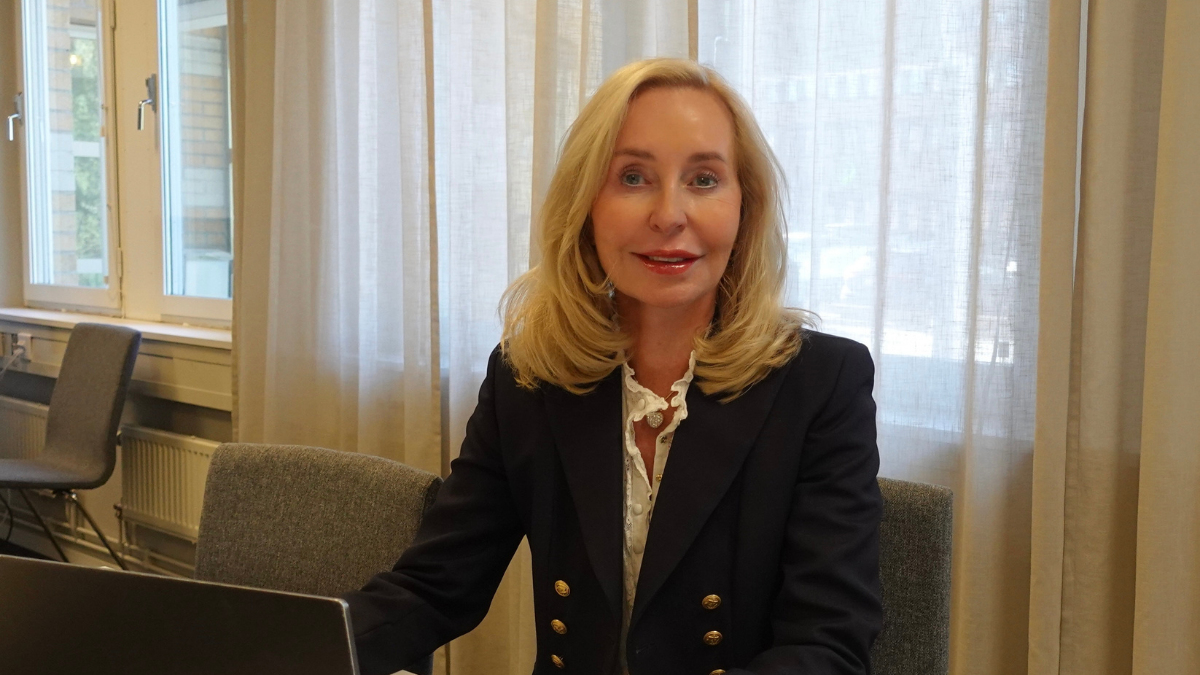
With more than thirty years of experience in law, finance, business leadership and board work, Eva de Falck has developed a broad understanding of what it takes to lead organisations through change. She has held several senior General Counsel positions at Handelsbanken and Swedbank, combining legal expertise with business and P&L responsibility, strategic leadership, risk, governance and regulatory compliance.
During her ten years at Swedbank, she served, among other roles, as Group General Counsel, with line responsibility for approximately 180 lawyers across six geographical markets and as a member of Group Executive Management. She also has extensive board experience and currently serves on the boards of Skandiabanken and Betsson, among others. She is Chair of Skandiabanken’s Risk and Audit Committee and Betsson’s Audit Committee.
When she later moved from finance into healthcare and social care, she joined Team Olivia through an interim assignment as a project manager, focusing on strategic initiatives, governance, legal matters, communications and regulatory compliance. The assignment later developed into a permanent role as General Counsel.
Today, Eva combines board assignments with selected interim and advisory assignments.
We met with Eva to discuss business-oriented leadership, crisis management, the role of the board, and why senior external expertise can make a significant difference when an organisation is undergoing change.
From legal specialist to business-oriented leader
You have moved from a legal career into roles with increasingly broad business and leadership responsibilities. Which experiences have been most important in shaping you as a leader?
“Before I started working in banking and finance, I spent seven years at the Swedish Export Credits Guarantee Board (EKN), a government agency that provides insurance to Swedish export companies and banks against risks associated with major projects and export credits.
At EKN, I had the opportunity to work internationally and travel all over the world, including Latin America, Saudi Arabia, Syria and China. It taught me a great deal about negotiation and gave me an understanding of how different cultures work. It is important to adapt and understand who you have in front of you.
I then moved to Handelsbanken, where I spent almost 13 years in various General Counsel roles. I was also head of the business-driven Export and Project Finance unit.
I subsequently spent ten years at Swedbank, where I started as General Counsel for the Swedish banking operations and later became Group General Counsel, with responsibility for legal matters across all of Swedbank’s business areas.
During my time at Swedbank, I also had the opportunity to serve on the boards of the bank’s subsidiaries and associated companies and on the boards of several savings banks. Among other things, I was Chair of two savings banks and served on several credit, risk and audit committees. This gave me a deep understanding of financial regulation, and the governance structures used in the financial sector – something that has been very valuable when working in other regulated industries.
I quickly realised that I enjoyed board work. It gave me a more holistic perspective than working solely as a specialist.”
You have a legal background but describe yourself as very business-oriented. How has the combination of law and business influenced the way you lead and make decisions?
“One important experience is that, as a lawyer, I have actually managed a business unit with both budget and P&L responsibility. I think that gave me a different level of business understanding than I would have had if I had worked exclusively within the legal function.
I have always been driven by business and results. For me, it has been important to understand the business rather than looking at things solely from a legal perspective.
It is also a strength to be able to combine different perspectives. The legal function provides an important understanding of risks and opportunities, but as a leader you also need to understand the business, the customer relationship and what can actually be implemented.”
Leadership when circumstances change
How have your experiences of crisis management and change leadership influenced you as a leader?
“It has been very educational and developmental. When you work with crisis management, you gain insights into both how you and others respond when situations become turbulent, and into the fact that the only real constant is change. It also gives you a certain perspective on what happens during a crisis. You know that situations eventually pass, which makes it easier to keep a cool head and remain stable when things are turbulent.”
What characterises leadership that works when circumstances change rapidly, and decisions have to be made under pressure?
“I strongly believe in empathetic leadership. You need to have a genuine interest in people to be a good leader and enjoy seeing employees grow and develop. That applies whether you are in a crisis or in a more stable situation.
A leader needs to be accessible, unpretentious and give people clear mandates. Of course, you cannot always tell your employees everything during a crisis, but it is important to be as transparent as possible in order to create involvement and engagement. Otherwise, a great deal of energy is spent speculating and wondering about what is happening.
It is important to provide regular updates. Employees need to know when they will receive the next update and what they can expect. It is particularly important to recognise the people who are actually keeping the business running during the crisis, so that operations are not affected more than necessary and can return to normal when the situation has stabilised.
One lesson I have taken from crisis management is that if a crisis appears likely to become prolonged, it can be a good idea to appoint an acting or interim manager to the regular management role.”
What could an interim solution have contributed in such a situation?
“An interim manager could have taken clear responsibility for a specific area and provided relief, allowing the permanent manager to focus on managing the crisis. When you are in the middle of a crisis, it is easy to try to carry too much yourself and attempt to fulfil every role.
It is important to understand that a crisis can last longer than you initially expect. You then need to consider how to organise leadership so that both the business and the people can sustain the situation over time.
When it comes to change management, the financial sector has undergone an enormous paradigm shift during the years I have worked, not least through digitalisation, which has fundamentally changed the way companies interact with customers. This has required a different type of leadership.
But regardless of how much change is taking place around you, people need to feel a sense of security. Otherwise, energy can easily be channelled in the wrong direction.”
The board should challenge – without taking over
You have extensive board experience. How does a board member know when to challenge and when to step back and let management do its job?
“I think most people who have worked on boards would agree that an effective board is characterised by an open environment where all different areas of expertise can be brought to the table. The board should make use of its collective expertise for the benefit of the company.
The board needs to maintain a strategic perspective and a holistic view and should not become too involved in operational management. At the same time, the board has a legal responsibility and must ensure that the company has effective governance systems, a functioning control environment and that the business is sound and sustainable.
I tend to think of the board as a dynamic sounding board. You should not step in and run the business, but you need to be willing to challenge and ask questions when necessary.
The role of the board also varies depending on the type of company. I have experience from boards of, for example, fintech companies and companies preparing for an IPO, where the board sometimes needs to be more operational. In a larger or listed company, the board needs to take a more strategic perspective and draw a clearer distinction between the roles of the board and management.”
Does that balance change when a company is in crisis or undergoing a major transformation?
“Yes, it can. In a pressured situation, the board often needs to be closer to the business, while at the same time being careful not to take over management’s responsibilities and thereby expand the responsibilities of the board members.
This is when it is particularly important to have a good dialogue with the CEO and management. The board needs to be able to ask the difficult questions and ensure that the company is taking the right course of action, while also giving management the right conditions to do its job.”
When do you think bringing in an interim manager is a good solution?
“It can be very valuable when you need to fill a strategic position quickly, while also needing time to consider what capabilities and profile are actually required in the long term.
When you join as an interim manager, you are not part of the existing hierarchy, which can give you greater freedom.
You are not perceived as a threat in the same way, and you can ask questions, challenge things constructively and often get very good answers. People are willing to help because there is less prestige involved. Everyone also knows that you are only there temporarily. That is one of the strengths of interim management. You come in with a clear assignment and can focus on what needs to be done here and now.
Interim management has been well established internationally for a long time, but it has really started to gain momentum in Sweden in recent years. I think that is very positive.
It can be a way to quickly fill a gap while creating time to find the right permanent solution. An experienced interim manager can contribute from day one, while also helping the organisation understand what needs to be in place going forward.”
From interim assignment to change leadership at Team Olivia
You joined Team Olivia through an interim assignment yourself. What did you take away from that experience?
“It was a very exciting move into a new industry. As a senior professional with extensive experience, you can often draw parallels between different businesses and industries and apply your experience in new ways. I personally benefited greatly from the governance model used in the financial sector, where business operations are separated from control functions such as risk, compliance and internal audit. It is a governance model that is becoming increasingly common in other regulated industries as well.
At Team Olivia, I joined as an interim project manager and was tasked with coordinating strategic initiatives relating to areas including communications, legal matters, common ways of working and processes, governance and regulatory compliance.
During that period, we worked on these issues in project form. I subsequently stayed on more permanently, first as a senior advisor and later as General Counsel.
It became a very good example of how an interim assignment can develop when there is a clear need and when the expertise brought into the organisation proves to be a good fit.
Team Olivia also gave me the opportunity to get to know the healthcare and social care sector, which, like financial services, is a highly regulated industry with an active supervisory authority. When I joined, Team Olivia was a large group with significant healthcare and social care operations in Sweden and Norway. During my time there, I was involved internally, among other things, in the divestment of the Swedish care business to Attendo and the Norwegian business to Humana.
The Swedish group then entered a new phase, focusing on personal assistance, where, in my role as General Counsel, I was also responsible for communications, corporate governance, quality and regulatory compliance.
From the outset, I had said that I did not see it as a five-year project. I thought perhaps two years, and that is how it turned out. We have now found a capable internal successor.”
Senior expertise in a new way
Going forward, you want to combine board assignments with advisory work and potential interim assignments. What do you think companies can gain from using senior expertise in this way?
“I want to continue working with board assignments going forward and potentially interim assignments, but preferably not full-time and with the possibility of working partly remotely. I want greater flexibility going forward and the opportunity to step in where my experience can make the greatest difference.
I believe there are many senior leaders who still want to work and contribute, but who do not necessarily want to take on a major permanent operational role. Interim assignments can provide an alternative way to continue their careers.
That is where I believe interim management has an important role to play. It is about making use of experience and expertise when and where they are genuinely needed.
There is a great deal of senior expertise that companies can benefit enormously from if they are prepared to use it in a flexible way. It is also a way of counteracting ageism.
For me, it is about continuing to contribute experience, perspective and energy – but in a way that works both for the organisation’s needs and for the stage of life I am in myself.”
#InterimLegal #InterimFinance #Boards