




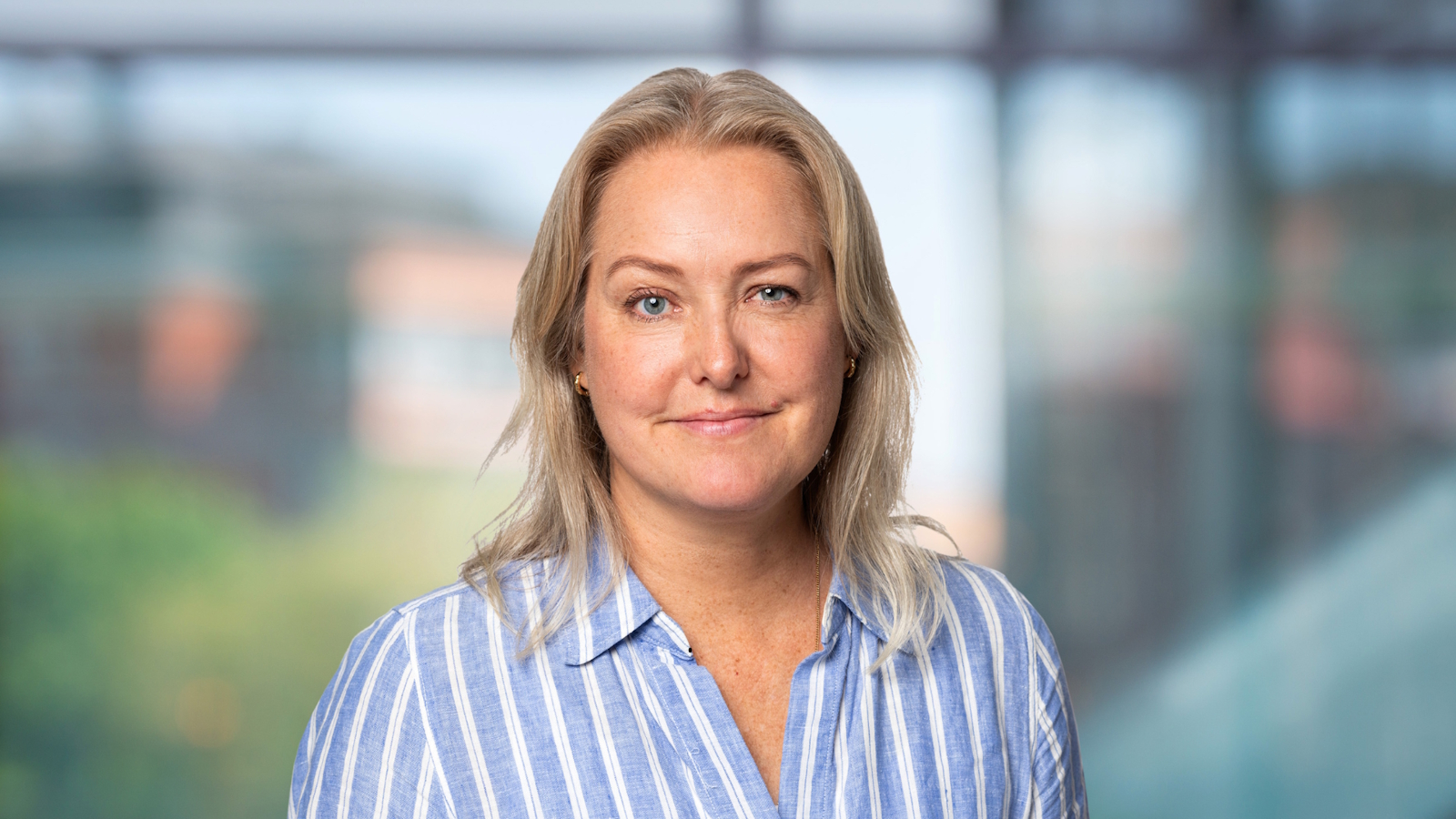
Kajsa Hessel is not a typical construction industry profile. With a background in behavioural science and HRM, she came to the community building sector via a detour – and found her industry. Since 2021, she has been the CEO of Svensk Byggtjänst (Swedish Construction Service), an independent knowledge hub founded in 1934, working to promote sustainable community building. She is also the chair of IQ Samhällsbyggnad (The Swedish Centre for Innovation and Quality in the Built Environment), a member of the Royal Swedish Academy of Engineering Sciences, and was awarded Community Builder of the Year in 2020.
Under her leadership, Svensk Byggtjänst has undergone a thorough transformation with a new strategic direction, a new owner’s directive, and a clearer focus on sustainability. We met with Kajsa for a conversation about leadership in times of change, the art of holding the course when resistance is strong, and why culture never changes on its own.
Your background is unusual for a CEO in the construction industry. How did you end up here?
“I am a behavioural scientist and originally planned to work with personnel. But when I graduated, the recruitment market was deregulated, and the entire industry opened up in Sweden. I ended up at a headhunting firm and became a manager after just six months. Since then, the common thread in my career has been change assignments within knowledge-intensive service companies, leading organizations through transformation and helping people to grow. I got into the construction industry by a detour, you could say. I had a period where I wanted to try something new and ended up at a small clothing producer with a focus on sustainability. It was meaningful, but turned out to be an extremely tough market. When that didn’t work out, I was offered the position of CEO for a project management company in the construction industry, and that’s where I found my industry. It was unexpected, but it is a sector with an enormous social significance. Everything from how roads are planned to how we design the environments we live in. Meaningful and complex at the same time.”
Svensk Byggtjänst received a new owner’s directive in 2022, and you initiated a thorough transformation. What was the most difficult decision you made?
“The most difficult decision, which I have realized in retrospect, was that we must practice what we preach. Svensk Byggtjänst exists to strengthen sustainable community building, but in order to guide others, we ourselves need to maintain a high standard. This meant a number of concrete and sometimes uncomfortable changes internally: we removed bonus systems and company cars, we eat vegetarian when we eat together, and we share rooms at conferences. This was not received without friction. I was naive in my hope that the organization would immediately understand the logic behind the changes. There was resistance, and it took effort to handle it. My strategy was to be available, to have many conversations and to give people space to move out of their resistance curve at their own pace – but without compromising on the direction. In retrospect, I would have done it differently and started at a different end, created more understanding and anchored it before I ripped off the band-aid.”
What did you learn about leadership from that experience?
“That communication should never be taken for granted, no matter how obvious a change may seem from above. As a leader, it is easy to think that it is enough to make the right decision, but leadership lies in the implementation. Sticking to the path and at the same time being responsive to where people are is a balancing act that requires both patience and perseverance. I also learned that courage and empathy are not mutually exclusive. You can make uncomfortable decisions and still do it with respect for the people who are affected.”
You hired external expertise to clarify the strategic direction. When is it right to bring in external help?
“It is right to do so when you need expertise that is not available internally – expertise that you do not need to have internally in the long run. But it is just as important that the external help leads to an actual transfer of competence in the organization, not just delivering a document that is then put in a drawer. In our case, we engaged a professor from the Stockholm School of Economics to help us put together the owner’s directive because we lacked experience with that process. It was an ambitious work where the entire management team moved its understanding to a new level. He left behind knowledge, not just a result. It is that type of external support that creates real value.”
Svensk Byggtjänst is owned by about thirty organizations with partially conflicting interests. How do you, as a leader, navigate in that landscape?
“That is one of the most specific challenges in my assignment. Among our owners, we have both employer and employee organizations – parties that in other contexts are on opposite sides of the negotiating table. This requires a clear common platform to stand on. The first thing I prioritized was to create a consensus around the owner’s directive. I had conversations with all the owners, and we worked together to create a picture of what the business’s mission actually is. Without that common ground, it is impossible to act with sufficient force and direction. We have an annual owner dialogue, a full day where we report on what we have done and listen to the owners’ perspectives and expectations for the coming period. It is a forum that creates transparency and participation without blurring the lines of responsibility.”
You lead an organization in a sector that is changing rapidly, with a weak economy and historical regulatory changes. How do you create stability when the outside world is unstable?
“I don’t believe that stability is about keeping change at a distance; it is neither possible nor desirable. Instead, it’s about building an organization that is comfortable with the uncomfortable. It’s a cultural issue as much as a structural one. In concrete terms, this means that we continuously challenge each other to move outside our comfort zones in a controlled and supportive way, so that the organization gradually gets used to handling new conditions. You have to normalize change as a permanent state rather than a state of emergency. We have also built an innovation system where anyone within the sector can submit an idea, a problem, or a challenge. Dedicated idea developers then take over and evaluate whether there is potential to pursue the issue further. It is a way of systematically taking care of signals from the outside world and transforming them into new knowledge.”
You have worked actively with cultural issues in the construction industry and received the Community Builder of the Year award, partly for that work. What is your most important insight?
“That people rarely behave badly because they want to be mean. Most people who maintain an exclusive culture do so because they were brought up in it, because they want to belong to a group, or because they have never fully reflected on the consequences. It is not an excuse, but it is an important starting point for how to drive change. What actually works is to have someone who benevolently asks the uncomfortable questions – over and over again – until it leads to a real change of opinion. Not confrontation, but by perseverance, questioning what is taken for granted. What is clear is that the macho culture in the industry harms everyone, not just those who are explicitly excluded. And the culture runs deep; it is transmitted already during the education by teachers who themselves have been shaped by the same system. The change is too slow. Barely noticeable, despite years of work.”
What drives you as a leader and what gives you energy?
“The assignment itself. I have been lucky enough to find jobs that don’t feel like work in the sense that they drain me. On the contrary, it is in my assignments that I recharge with energy, and it is in the leadership role, in the complex issues and in meeting people who want to develop, that I really thrive. It is a privilege that I do not take for granted. When I am off, I prioritize time with family and close friends.”
#Construction #Leadership #Transformation